01 Hardware Control System Advantages
Siemens PLC fully closed-loop automatic control with high-precision sensor acquisition
High-Precision Acquisition
Minimum acquisition unit of 1 mV for voltage and 10 mA for current, precisely capturing tiny fluctuations in polarization curves at low current density to meet the high-precision needs of fundamental catalysis research.
Triple Closed-Loop T/P/F Control
Temperature control accuracy ≤ ±1 °C, flow linearly adjustable from 20–200 ml/min, real-time closed-loop pressure regulation, with no drift over long-duration durability tests.
24h Unattended Operation
Built-in safety interlocks (auto shutdown on over-temperature, over-pressure, over-current, liquid-loss), programmable stepped-current durability routines, and automatic overnight data acquisition.
02 Electrochemical Testing Capabilities
Full-dimensional electrochemical characterization supporting multi-variable orthogonal material screening
PEMWE (Proton Exchange Membrane Water Electrolysis) Test Data
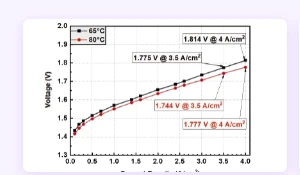
PEMWE polarization curves at different temperatures (65 °C / 80 °C)
Tested at 65 °C and 80 °C, showing the voltage–current density characteristic curve of the PEMWE cell. Covers 0–4 A/cm² and evaluates the effect of temperature on electrolysis efficiency, providing data support for operating-condition optimization.

PEMWE 8-channel consistency evaluation (≤10 mV at same current density)
8 channels tested in parallel; voltage deviation across channels ≤10 mV at the same current density, verifying the high consistency of MEA and catalyst coating processes in batch production, meeting industrial-scale manufacturing requirements.
AEMWE (Anion Exchange Membrane Water Electrolysis) Test Data
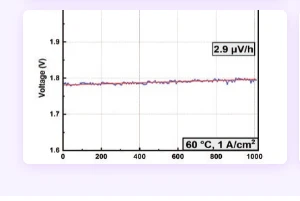
AEMWE 1000 h stability test
At 60 °C and constant 1 A/cm², the AEMWE cell ran continuously for 1000 h with a degradation rate of only 2.9 μV/h, demonstrating excellent long-term stability and validating the durability of the MEA and catalyst.
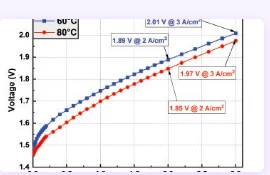
AEMWE polarization curves at different temperatures (60 °C / 80 °C)
Voltage–current density curves tested at 60 °C and 80 °C. Good performance at low current density; comparing performance across temperatures provides a data basis for AEMWE process optimization and scale-up.
03 Process & Structure Adaptation Advantages
Dedicated PEM & AEM test platforms with full-process matching
Independent PEM / AEM Platforms
The PEM bench is dedicated to pure-water electrolysis; the AEM bench to alkaline electrolyte. The two platforms are independently designed to ensure test accuracy and safety.
CCM / CCS Dual-Process Support
The MEA production line supports both mainstream MEA processes: catalyst-coated membrane (CCM) and catalyst-coated diffusion layer (CCS).
Corrosion-Resistant Low-Impedance
Pt-coated titanium and 316L stainless steel flow-field plates, ohmic impedance ≤10 mΩ·cm², no corrosion or metal-ion contamination in alkaline systems.
Full-Spec Customization
Active area 4–100 cm², pressure rating 0–3.5 MPa, channel count and power level can all be customized to experimental requirements.