
1. Background: the AEM cathode lifetime dilemma
Anion-exchange membrane (AEM) water electrolysis combines the low cost of alkaline electrolyzers with the high efficiency of PEM electrolyzers, making it a strong candidate for next-generation green hydrogen production. However, one of its biggest engineering bottlenecks is the lack of cathode hydrogen-evolution (HER) catalysts that are both cheap and durable—conventional solutions either rely on expensive platinum-group metals or deactivate rapidly under high-current, strongly alkaline, and intense gas-evolution conditions.
At ampere-level current densities, hydrogen bubbles scour the catalyst layer like "micro-bombs," causing active components to detach; meanwhile the alkaline medium continuously corrodes transition metals, dissolving the catalyst quickly. Therefore, achieving ten-thousand-hour-scale ultra-long lifetime without sacrificing activity has become a global research focus, and a direct test of the long-term stability capability of AEM water electrolysis test benches.
2. Material design: a "dumpling-wrapping" core–shell encapsulation
The Sun team took a different path, using a simple process of low-temperature hetero-nucleation (only 50°C) combined with high-temperature annealing (500°C): precursor crystals containing nickel and molybdenum are first grown on a nickel-foam substrate; during annealing the precursor releases water molecules, "blowing" abundant mesoporous channels inside the material, while nickel atoms are "trapped" in the MoO₂ matrix, forming a nickel-core/MoO₂-shell core–shell structure—much like wrapping nickel nanoparticles in a porous dumpling skin.
- 🔒 Strong anchoring: nickel particles are firmly encapsulated by dense MoO₂, preventing stripping by high-speed evolving hydrogen bubbles.
- 🌀 Fast mass transport: the interconnected mesoporous network lets reactants and product bubbles move quickly in and out, alleviating local concentration polarization.
- 🛡️ Corrosion resistance: the MoO₂ shell isolates the internal nickel from the alkaline medium, maintaining long-term intrinsic activity.
3. Performance comparison: 25,000 hours vs. conventional nickel cathodes
This encapsulation structure delivered an order-of-magnitude performance leap. Key metrics of the new core–shell cathode versus conventional nickel-based cathodes are compared below:
| Metric | Mesoporous MoO₂-encapsulated Ni (this work) | Conventional Ni-foam cathode | U.S. DOE 2026 target |
|---|---|---|---|
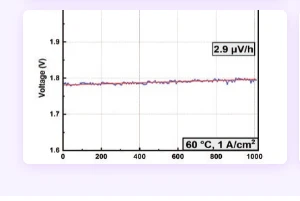
| Continuous operation at 1,000 mA/cm² | >25,000 h | Hundreds to thousands of hours | — |
| AEM electrolyzer current density @2.0 V | 10.2 A/cm² | Far below | Significantly below |
| Degradation rate | Negligible | Obvious decay | Low decay |
| Noble-metal loading | Zero Pt, zero Ir | Zero noble metal | Reduced noble-metal dependence |
| Core synthesis temperature | Low-temp nucleation + 500°C anneal | — | — |
Notably, the catalyst depends entirely on neither platinum nor iridium, comprising only abundant elements such as nickel and molybdenum—a significant advantage in cost and resource security. For MEA preparation lines and catalyst slurry preparation processes, this means noble-metal-free cathode electrodes can move from "lab curiosities" toward batch-producible, scalable industrial solutions.
4. Mechanistic insight: how mesopore confinement locks in activity
The team revealed the root of the core–shell structure's stability through in-situ IR, X-ray absorption spectroscopy, and mechanical testing:
- 🧪 Confinement effect: the MoO₂ mesoporous framework imposes both geometric and electronic confinement on nickel nanoparticles, suppressing aggregation and dissolution.
- 🧪 Interface buffering: the core–shell interface acts as a "spring," cushioning the mechanical shock of hydrogen-bubble detachment and protecting catalyst-layer integrity.
- 🧪 Hydrophilic–breathable synergy: the mesoporous structure balances electrolyte infiltration with rapid bubble release, extending electrode life from a fluid-dynamics perspective.
Academician Licheng Sun of the Center of Artificial Photosynthesis for Solar Fuels (CAP) at Westlake University stated: "Making electrolyzers run stably for years like household appliances is the core bottleneck of green-hydrogen industrialization. We have shown that, through clever materials design, cheap abundant elements can also shoulder the burden of industrial-scale, long-life operation." (Source: the Nature Catalysis paper and related Westlake University coverage)
5. Implications for hydrogen test equipment
The 25,000-hour ultra-long-life data raise entirely new requirements for the hydrogen test-equipment industry, and point the way for equipment makers to upgrade:
- ⚙️ Ten-thousand-hour automated testing: AEM water electrolysis test benches must support unattended operation, μV-level online voltage monitoring, and automatic fault diagnosis to validate the new generation of long-life cathodes.
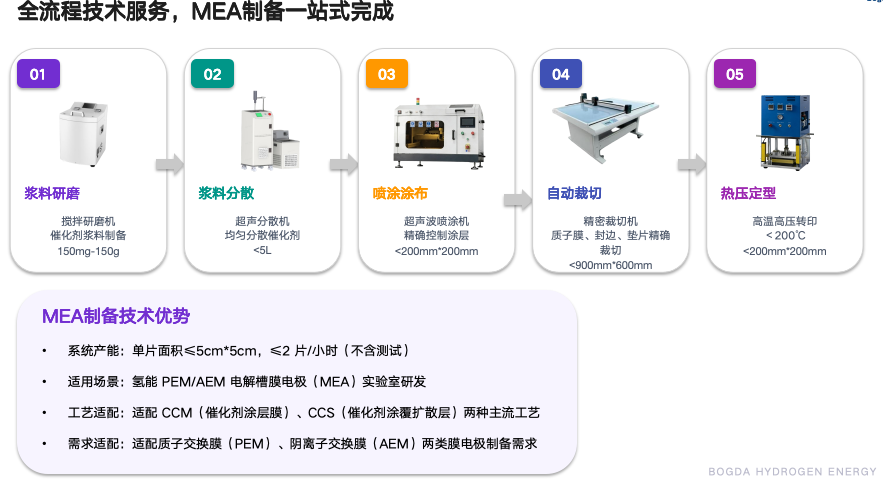
- ⚙️ Full-process MEA coordination: slurry formulation of the cathode catalyst layer, ultrasonic-spray film formation, and hot-press encapsulation must be jointly optimized with ultrasonic dispersers, ultrasonic coaters, and precision cutters.
- ⚙️ Fixture and consumable support: electrolyzer test fixtures and MEA test fixtures must support differential-pressure control and independent anode/cathode potential monitoring at ampere-level currents, matching industrial validation scenarios.
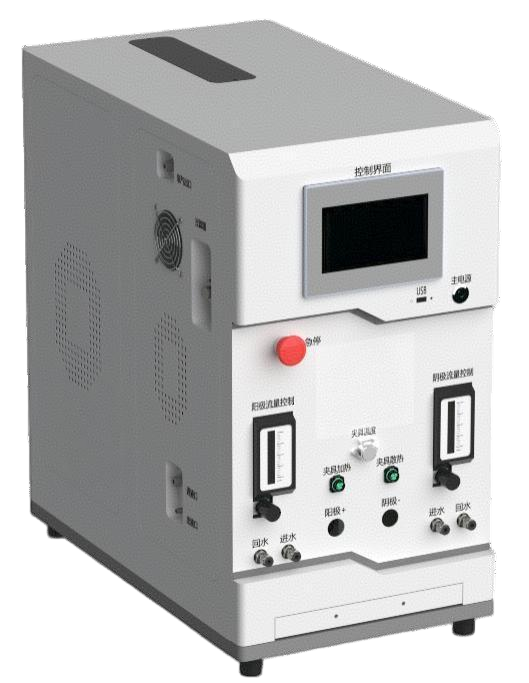
Hefei Borgda Hydrogen Energy Technology Co., Ltd. independently develops AEM water electrolysis test benches supporting wide current-density scanning, online EIS impedance analysis, and long-term stability automated testing. Its MEA preparation lines cover the full process of grinding, dispersing, spraying, cutting, and hot pressing; its electrolyzer test fixtures and MEA test fixtures support independent anode/cathode feeding and differential-pressure control, providing integrated equipment support for noble-metal-free electrode validation to universities and research institutes.
(This article is compiled based on publicly available research progress.)


